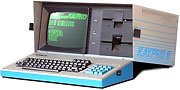
Yesterday was the 25th Anniversary of the release of the IBM PC. PC World has published a story on "The 25 Greatest PCs of All Time." I didn't get my first computer until the summer of 1983.
Imagine my surprise to find my first computer, a Kaypro II, was listed as the 25th greatest computer by PC World. I didn't expect it to make the list. It was not an IBM PC and it was not a DOS computer, but it was less than half the price, luggable to libraries, and good enough to format a doctoral disseration.
The most difficult task I had to perform was to convince the administrators of the doctoral program at Southwestern Baptist Theological Seminary that my Kaypro and Word Star's WYSIWYG format could produce output that conformed to the Chicago Manual of Style. I believe I was the first student at Southwestern Seminary to get permission to do a computer generated doctoral disseration.
I used my Kaypro for a year longer than the journalist quoted by PC World. I didn't buy my first DOS computer until 1992 -- a Gateway 486.


5 comments:
I graduated high school in '79--the next year we got classroom computers. After I figured out that Christians were supposed to be peacemakers, not warriors, I got out of the army and went to college. I visited the computer lab from time to time, but the screens were hard to read and the dot-matrix printing was worse. So, I mostly stuck to my electric typewriter.
I kept to that until meeting my wife in seminary. She had a self-contained wordprocessor and I used that until we bought our first PC during my doctoral work at SBTS--in '93--just far enough in front of my dissertation to give me a chance to get used to it. It had first generation Windows on it. (Even then my sister told me that Windows was a nightmare and to learn an early version of Lexus. I should have.)
Not until my dissertation was done did I treat my computer as anything more than a glorified wordprocessor. I was still trying to figure out email in '96. At my first teaching interview a smart techie asked me how I would use computer technology in my teaching--and I hadn't a clue.
I never thought the day would come when most of my research would be done "online," or how much I would depend on the web for organizing, etc.
I still can barely use a laptop, though, and prefer to take notes on speeches, lectures, and sermons the old fashioned way--and transcribe later.
My children use computers as easily as swimming. Amazing.
It is amazing.
I don't know what life was like before television. My children don't know what life was like before computers.
What's next?
Steve,
I'm fairly sure you were the first to get a dissertation done on a computer, but I think was the first to get approval to use a computer for a dissertation. Either that or we were petitioning the committee around the same time.
I know that their policy prohibited the use of computers for dissertation work when I bought my Kaypro. I had to convince them that it wouldn't come out with both the right and left hand margins justified with a lot of extra spaces between words.
I also used a Brother CE-50 with interface box. I've still got both of those, but no longer have the computer.
I also ought to credit Steve Haines for teaching me most of what I knew about computers until I got my Kaypro.
He's responsible, for good or for ill, for getting me started using PC's.
He's also the first person to receive an e-mail from me -- back in the days of Compuserve. I sent him an e-mail from Houston, Texas and half an hour later got his response from Ukraine. When I discovered that I didn't have to pay long distance phone charges for that overseas e-mail, I realized that online computing was the wave of the future.
Steve,
I had no idea that you were paying to send e-mails out of the USSR. Since we were both on Compuserve, I thought the cost was the same for both of us.
I was paying $19.95 a month with unlimited e-mail usage.
Had I known it cost you so much I would have sent you some money to pay the bill. $700.00 in 1992 was a lot of money. It still is.
Post a Comment