Thursday, December 31, 2009


Monday, December 28, 2009
10 Most Popular Blogs of 2009
Based on the amount of traffic generated on this weblog, here are this year's 10 most popular blogs:
Stepping Away From Fundamentalism, Step One
Stepping Away From Fundamentalism, Step Two
Stepping Away From Fundamentalism, Step Three
Stepping Away From Fundamentalism, Step Four
Stepping Away From Fundamentalism, Step Five
Stepping Away From Fundamentalism, Step Six
Stepping Away From Fundamentalism, Step Seven
Another Echo from the Radical Christian Right
Conscience and the Word of God
On the Profanity of Ten Commandments Monuments
Stepping Away From Fundamentalism, Step One
Stepping Away From Fundamentalism, Step Two
Stepping Away From Fundamentalism, Step Three
Stepping Away From Fundamentalism, Step Four
Stepping Away From Fundamentalism, Step Five
Stepping Away From Fundamentalism, Step Six
Stepping Away From Fundamentalism, Step Seven
Another Echo from the Radical Christian Right
Conscience and the Word of God
On the Profanity of Ten Commandments Monuments
Friday, December 25, 2009
Three Cardinals and a Robin

A few minutes ago, for an instant, three cardinals and a robin were sunning themselves together on a tree at the back of my house. There are several other less colorful birds on the tree with them. I had just enough time to zoom in for the picture before two of the cardinals moved.
The same tree branches that stretch out from a tree near my house in the picture of the blizzard in my previous blog are visible in the foreground of this picture. Two cardinals and a robin are framed within the fork at the end of the tree branch that is in the foreground. That will give an idea of the distance from which I was taking this picture. The high resolution image from my camera is much better than what can be uploaded.
Thursday, December 24, 2009
The view from our rear window during this Oklahoma Blizzard
 Will, Monica & Jose are stranded in Los Angeles. Their flight was cancelled due to the blizzard conditions in Oklahoma.
 At the moment, the snow is falling horizontally due to 45-55 mph winds. The snow is landing on top of about 1/2 inch of ice from the freezing rain that fell this morning. Snow accumulation at my house is already 4-6 inches with another 4 inches expected.
Big Government Cheaper than Private Industry

After all the claims that private industry could perform at less expense than government, here's the lead paragraph from a story in today's Washington Post:
The Defense Department estimates it will save an average of $44,000 a year for every contractor it replaces with full-time federal personnel to perform critical defense jobs, according to the House-Senate conference report on the fiscal 2010 defense appropriation bill.
Monday, December 21, 2009
Podcast: God's Enlightening Word
Podcast (27Mb Mp3) of Dr. Bruce Prescott's 12-20-2009 "Religious Talk" radio program. Dr. Prescott talks about "God's Enlightening Word" and reads excerpts from Russell King's "It's Time to Put Christ back in Christmas."
Thursday, December 17, 2009
Democrats as Bad as Republicans
A public option for health insurance makes a lot of sense to me.
Lowering the age for medicare eligibility to 55 years or younger makes a lot of sense to me.
Preserving the system we have now makes no sense to me.
I don't know who to trust about proposals for healthcare reform that lack either a public option or a medicare buy-in.
I do know that if the following information from Democracy for America is true, then the healthcare reform that the administration is now pushing appears questionable.
Here's what DFA is saying:
Lowering the age for medicare eligibility to 55 years or younger makes a lot of sense to me.
Preserving the system we have now makes no sense to me.
I don't know who to trust about proposals for healthcare reform that lack either a public option or a medicare buy-in.
I do know that if the following information from Democracy for America is true, then the healthcare reform that the administration is now pushing appears questionable.
Here's what DFA is saying:
Senate leaders are all over Washington claiming they finally have a healthcare reform bill they can pass, as long as they remove the public option. After all, they say that even without a public option, the bill still "covers" 30 million more Americans.Democrats are as bad as Republicans in regard to obscuring the effects of legislation. It's getting harder and harder to tell who is on the side of truth and transparency.
What they are actually talking about is something called the "individual mandate." That's a section of the law that requires every single American buy health insurance or break the law and face penalties and fines. So, the bill doesn't actually "cover" 30 million more Americans - instead it makes them criminals if they don't buy insurance from the same companies that got us into this mess.
Wednesday, December 16, 2009
How to put Christ back in Christmas
Russell King has posted an outstanding diary entry at Steet Prophets entitled "It's time to put Christ back into Christmas."
The entry needs to be read in its entirety. To give you a hint of the perspective from which King writes, here's a footnote from his blog:
The entry needs to be read in its entirety. To give you a hint of the perspective from which King writes, here's a footnote from his blog:
*When we insist that others join in our customs, use the words we like to use and participate in our celebration, we are violating the life and lessons of Jesus and ripping Christ from the heart of Christmas. When we force non-Christians to utter the name of Christ when they do not believe in Him, we are making mockery of the Christ in Christmas. When we take offense when others celebrate the season in ways that are meaningful to them, and are different from our ways -- especially when we pretend that respecting others' celebrations constitutes a "war on Christmas" -- we are ignoring the spirit of Christ. When we insist that our government join in our religious celebration, we are acting exactly like those who opposed Christ. When we insist that the tax dollars of non-Christians be used to celebrate our Christian holiday, we are ignoring Christ's teaching (Matthew 22:21) and tearing Him out of Christmas. When we put more emphasis on the word "Christ" than on the message of Christ, we are making a mockery of Christmas and the one whose birth we celebrate (we don't do salvation by syllables). When we make a fuss over "Xmas," we show that we don't know much about our own religion's history: In Greek, the letter Χ (chi), is the first letter of Christ, and it, or the similar Roman letter X, has been used as an abbreviation for Christ since the mid-16th century. Xmas has been used for Christmas, by Christians, for centuries.
Tuesday, December 15, 2009
The Perils of Ignoring the 14th Amendment
The citizens of Ashville, North Carolina recently elected an atheist, Cecil Bothwell, to serve on their city council. North Carolina's state constitution prohibits anyone "who shall deny the being of Almighty God" from holding public office. The state's GOP and the Religious Right have filed suit to remove Bothwell from office.
Among those opposed to Bothwell's holding office is Bryan Fischer of the American Family Association who says that Article VI of the U.S. Constitution does not apply in North Carolina or any other state. Article VI of the U.S. Constitution says "no religious test shall ever be required as a qualification to any office or public trust under the United States."
Fischer, North Carolina's GOP, and the Religious Right have long been reviving "states rights" arguments that legitimated the losing causes of the civil war era. This time instead of slavery, they are trying to legitimate the establishment of religion and the persecution of persons of minority faith and no faith.
If the 14th amendment did not apply all the rights contained in the Bill of Rights to the citizens of every state and if the North Carolina GOP, the Religious Right, and Fischer's contentions were true, what else would that mean?
It would mean that freedom of speech, press, assembly, petition and the free exercise of religion are no longer rights but mere benefits granted and withdrawn at the shifting whims of the electorate in every state. It would mean that no one can be sure that they will be free from unreasonable searches and seizures or free from cruel and unusual punishment. It would mean that we have no guarantee of legal counsel or of a speedy trial or of a public trial before a jury of our peers. In effect, it would make the Constitution of the United States and the Bill of Rights a hollow and meaningless document.
It wouldn't surprise me if Fischer and the Religious Right would gladly trade these birthrights for a bowl or two of Chrstian Nationalist porridge.
It would surprise me if they would be happy to learn that they were no longer guaranteed the right to keep and bear arms -- and that would also be in jeopardy.
Among those opposed to Bothwell's holding office is Bryan Fischer of the American Family Association who says that Article VI of the U.S. Constitution does not apply in North Carolina or any other state. Article VI of the U.S. Constitution says "no religious test shall ever be required as a qualification to any office or public trust under the United States."
Fischer, North Carolina's GOP, and the Religious Right have long been reviving "states rights" arguments that legitimated the losing causes of the civil war era. This time instead of slavery, they are trying to legitimate the establishment of religion and the persecution of persons of minority faith and no faith.
If the 14th amendment did not apply all the rights contained in the Bill of Rights to the citizens of every state and if the North Carolina GOP, the Religious Right, and Fischer's contentions were true, what else would that mean?
It would mean that freedom of speech, press, assembly, petition and the free exercise of religion are no longer rights but mere benefits granted and withdrawn at the shifting whims of the electorate in every state. It would mean that no one can be sure that they will be free from unreasonable searches and seizures or free from cruel and unusual punishment. It would mean that we have no guarantee of legal counsel or of a speedy trial or of a public trial before a jury of our peers. In effect, it would make the Constitution of the United States and the Bill of Rights a hollow and meaningless document.
It wouldn't surprise me if Fischer and the Religious Right would gladly trade these birthrights for a bowl or two of Chrstian Nationalist porridge.
It would surprise me if they would be happy to learn that they were no longer guaranteed the right to keep and bear arms -- and that would also be in jeopardy.
Monday, December 14, 2009
Climate Change and Pascal's Wager
Michael Westmoreland-Wright at the Levellers blog has written one of the best opinion pieces that I have seen in regard to global warming. Entitled "Pascal's Wager and the Global Warming Debate," Westmoreland-Wright astutely examines the possible effects of climate change by the logic of Pascal's wager about the existence of God. Here's his conclusion:
So, it seems to me that the smart wager would be that global warming is real, really caused by greenhouse gasses, and can and should be prevented or minimized through massive efforts cut greenhouse gas emissions and develop green energy alternatives. The potential gains to be made even if this is wrong and the potential costs if it is right and we do nothing (or not enough) seem clear to me.
I am also puzzled as to why conservatives (self-declared) are so opposed to efforts to stop global warming. After all, to be conservative is, by definition, to be cautious. So, if something is potentially disastrous, but not all the evidence is in, the cautious, conservative thing to do is to stop the potentially bad behavior causing it while investigating further. If I am speeding in a car toward what looks like a cliff or wall, but could be only a mirage, the conservative thing would be to slow down or stop while investigating further–not to step on the gas pedal in a potentially suicidal manner. But the latter is what so-called conservatives are doing regarding global warming. It's just not rational. It's reckless -- as conservatives always claim liberals to be.
Saturday, December 12, 2009
Friday, December 11, 2009
On Being a Ruralpolitan

The Wall Street Journal has posted a story entitled "Green Acres is the Place to Be" that chronicles an exodus from cities back to "the country."
The article describes people moving from the sprawl and congestion of cities to rural areas as "ruralpolitans."
After living eleven years in the Dallas-Fort Worth metroplex, then eleven years in the Houston megasprawl, I've spent the last eleven years as a "ruralpolitan" on the outskirts of Norman in the Oklahoma City area.
WSJ is right about green acres being the place to be. Concrete jungles and manicured lawns can't compete with life near the lake, acres of trees, soaring eagles, wild turkeys, fawns and deer.
Tuesday, December 08, 2009
On the Advent of the Holiday Sales Police
While most free and faithful Christians are trying to celebrate this season of Advent, Liberty Counsel has posted a list of "Naughty" and "Nice" retailers. The list differentiates retailers according to how they greet customers over the holiday season and whether their advertising is focused on Christian customers.
The greetings and advertisements of American retailers have nothing to do with Christ, Christmas or the Advent season.
If they truly want to share in the Spirit of the season, the people at Liberty Counsel need to spend more time reading their Bibles and less time shopping and thumbing through advertisements.
The greetings and advertisements of American retailers have nothing to do with Christ, Christmas or the Advent season.
If they truly want to share in the Spirit of the season, the people at Liberty Counsel need to spend more time reading their Bibles and less time shopping and thumbing through advertisements.
U.S. and Israel at Odds over Iran

David Ignatius has posted an Op-Ed at the Washington Post describing the depressing results of a simulation game at Harvard about the looming confrontation over Iran's nuclear program.
It appears that Iran holds most of the chips in this game. Here's Ignatius' summary of the exercise:
My scorecard had Team Iran as the winner and Team America as the loser. The U.S. team -- unable to stop the Iranian nuclear program and unwilling to go to war -- concluded the game by embracing a strategy of containment and deterrence. The Iranian team wound up with Russia and China as its diplomatic protectors. And the Israeli team ended in a sharp break with Washington.Ignatius' essay did not discuss the reaction of American Christian Zionists to the scenario proposed.
You can be sure that they will demonstrate more loyalty to Israeli interests than to American interests. They are on a countdown to Armageddon.
Monday, December 07, 2009
Martin Marty on Disponsibilité
Martin Marty's 2004 Commencement Address at Eastern Mennonite University provides on of the best summaries that I've seen of the French philosopher Gabriel Marcel's idea of disponsibilité:
A Marcel scholar (Seymour Cain) says that it is easiest to define disponibilité by looking at its opposites: "unavailability," "a holding-back, self-adherence, closed-in-ness," Kierkegaard's Indesluttedhed (in Danish), or "shut-in-ness." The "disposable" person opens freely and gives herself unreservedly in a mutuality of presence, "the indisposable person is self-preoccupied, encumbered, self-enclosed, incapable of giving himself, of opening up, of giving out. If he listens to me, he gives me only his ear, the outward attitude, but he refuses me himself, for he cannot 'make room' for anyone else in himself."In three brief paragraphs Marty has provided a very good introduction to a key idea in the thought of a very neglected and overlooked philosopher, Gabriel Marcel. For those interested in learning more, here's a link to the best book from which to understand Marcel's thought, Creative Fidelity.
Being available is thus not only a habit of expression but a deep focus on personal philosophy. It is not only a matter of psychology or bodily posture, but of the spiritual life. Marcel sometimes used a kind of economic metaphor, "opening a line of credit" for someone else. "I put myself at the disposal of, or again I make a fundamental engagement which bears not only on what I have, but on what I am." You give credit to another, and you are giving a gift to yourself. Marcel: "To be unavailable is to be in some manner, not only occupied, but encumbered by the self."
A theological or ethical dimension appears: Marcel speaks of "self-presence:" "the portion of creation which is in me, the gift which from all eternity has been given me of participating in the universal drama, of working, for example, to humanize the Earth, or on the contrary to make it more uninhabitable." And "from the very beginning there must be a sense of stewardship: something has been entrusted to us," and we are responsible to the Giver of the trust, the "Other," God. What is the whole drama of God visiting the world in Israel and the prophets and, finally, in the divine Son, in the life and death and resurrection of a Jesus who "condescends" and is a "com-presence," a shaper of community, available to us and through us, in prayer and work.
Saturday, December 05, 2009
Stonehenge Reloaded
Wally Wallington of Flint, Michigan demonstrates the technology -- without the use of machinery -- that he thinks the ancients used to erect Stonehenge.
You have to see it to believe it.
Friday, December 04, 2009
What About Medicare-for-All?
Senator Bernie Sanders of Vermont has offered an amendment to the healthcare reform bill that would make medicare available to everybody.
Medicare is one of the most popular government programs in existence.
I think it is a worthy alternative to the private insurance-if-you-can-get-it program that we have now.
Medicare is one of the most popular government programs in existence.
I think it is a worthy alternative to the private insurance-if-you-can-get-it program that we have now.
Tuesday, December 01, 2009
Dr. Coburn's Alarming Prognosis
Oklahoma Senator Tom Coburn, M.D. tells Americans that they are going to "die sooner" if healthcare reform passes.
Somebody who is uninsurable and terminally ill needs to sue him for malpractice.
Monday, November 30, 2009
How Wade Burleson has Changed
Wade Burleson's blog entry today briefly describes how his thinking has changed over the past few years. Here's a change that I find most noteworthy:
I would still feel the need, at times, to let others -- especially non-Baptists -- know that I do not agree with all the actions taken and pronouncements made by the leadership of the denomination.
Though I love doctrine as much, if not more, than I ever have loved it, I have absolutely zero interest in convincing people that I am "right" in my beliefs. I am always ready to give an answer for what I believe, but I'd rather people know that I love them and I have zero need to let them know I disagree with them.If all Baptists could agree with this, there would be few divisions among us.
I would still feel the need, at times, to let others -- especially non-Baptists -- know that I do not agree with all the actions taken and pronouncements made by the leadership of the denomination.
Tuesday, November 24, 2009
Another Echo from the Radical Christian Right
Currently, there is a wave of discussion on the internet and over the airwaves about the Manhattan Declaration which is yet another echo from the sound chambers of the radical Christian right.
The signatories of the Manhattan Declaration are a Who’s Who of the Radical Christian Right in America. It was no surprise to see Richard Land, Jimmy Draper, Al Mohler, Bob Reccord and Daniel Akin along with Gary Bauer, Chuck Colson, James Dobson, Jonathan Falwell, Harry Jackson, Marvin Olasky, Tony Perkins, Alan Sears, Mark Tooley, George Weigel and nine Catholic archbishops. It was a surprise to see Robert Sloan’s signature on this list. I thought he would have had the wisdom to steer clear from aligning himself with such a blatant effort to fan the flames of cultural conflagration.
In my mind, there's something about Jesus' injunction to "let your yea be yea, and your nay be nay" (Matt. 5:37) that is applicable beyond oath-taking situations and confirms the truth that "anything beyond these is of the evil one." Christians have no business embellishing the truth and twisting it for political purposes and that is what the Manhattan Declaration does from beginning to end.
Nowhere does the Bible state that human beings are stamped with the image of God at the moment of conception. Theologians have been debating what the ancients called "ensoulment" for millennia without resolving the issue. There are good reasons for believing that "ensoulment" occurs at the moment of conception. There are equally good reasons for believing that consciousness is an essential component of the image of God. Before the biological substrate for consciousness develops -– sometime between 13 and 24 weeks -– it is reasonable to question whether the imago dei exists within the forming body. The answer to this question has enormous implications for the morality of not only abortion but also contraception and stem cell research. It deserves to be openly discussed and honestly debated, not stonewalled.
The Manhattan Declaration presumes that no honest debate exists over the inception of the image of God. It also strongly implies that those who disagree with their declaration sanction infanticide, euthanasia and Nazi death camps. It is dishonest for these signees to act as though their understanding of this issue is infallible and as though they are the sole possessors of faith, logic, truth and reason.
They give the same dishonest and disrespectful treatment to those who support homosexual unions. Their ability to proclaim biblical convictions from their pulpits are protected by the First Amendment. As long as the First Amendment is enforced, no law will ever be upheld that forces Christian ministers to perform gay marriages against their will. That same First Amendment, however, would also prohibit Christians from making the law conform to the bible and thereby prohibit the civil union of homosexuals. Homosexuals have an equal right to the same religious freedom and liberty of conscience that Christians enjoy.
I suspect that many of the signers of the Manhattan Declaration fully understand the implications of the First Amendment in relation to their opposition to homosexual unions. That's why some of them believe that our pluralistic democracy is heresy and hope to replace it with a Christian theocracy ruled by their interpretation of biblical law. That's also why their declaration carefully defines both religious liberty and conscience in exclusively biblical terms. Presupposed throughout the Manhattan Declaration is the belief that only Christians are assured the right to religious liberty. It is hard to find any evidence of even the slightest recognition that someone could conscientiously disagree with either their faith or their interpretation of the bible.
Those with consciences formed differently than those of the signers may well perceive that the purported call of conscience issued by the Manhattan Declaration is but another echo from the ever so gradually emptying chambers of the radical Christian right.
The signatories of the Manhattan Declaration are a Who’s Who of the Radical Christian Right in America. It was no surprise to see Richard Land, Jimmy Draper, Al Mohler, Bob Reccord and Daniel Akin along with Gary Bauer, Chuck Colson, James Dobson, Jonathan Falwell, Harry Jackson, Marvin Olasky, Tony Perkins, Alan Sears, Mark Tooley, George Weigel and nine Catholic archbishops. It was a surprise to see Robert Sloan’s signature on this list. I thought he would have had the wisdom to steer clear from aligning himself with such a blatant effort to fan the flames of cultural conflagration.
In my mind, there's something about Jesus' injunction to "let your yea be yea, and your nay be nay" (Matt. 5:37) that is applicable beyond oath-taking situations and confirms the truth that "anything beyond these is of the evil one." Christians have no business embellishing the truth and twisting it for political purposes and that is what the Manhattan Declaration does from beginning to end.
Nowhere does the Bible state that human beings are stamped with the image of God at the moment of conception. Theologians have been debating what the ancients called "ensoulment" for millennia without resolving the issue. There are good reasons for believing that "ensoulment" occurs at the moment of conception. There are equally good reasons for believing that consciousness is an essential component of the image of God. Before the biological substrate for consciousness develops -– sometime between 13 and 24 weeks -– it is reasonable to question whether the imago dei exists within the forming body. The answer to this question has enormous implications for the morality of not only abortion but also contraception and stem cell research. It deserves to be openly discussed and honestly debated, not stonewalled.
The Manhattan Declaration presumes that no honest debate exists over the inception of the image of God. It also strongly implies that those who disagree with their declaration sanction infanticide, euthanasia and Nazi death camps. It is dishonest for these signees to act as though their understanding of this issue is infallible and as though they are the sole possessors of faith, logic, truth and reason.
They give the same dishonest and disrespectful treatment to those who support homosexual unions. Their ability to proclaim biblical convictions from their pulpits are protected by the First Amendment. As long as the First Amendment is enforced, no law will ever be upheld that forces Christian ministers to perform gay marriages against their will. That same First Amendment, however, would also prohibit Christians from making the law conform to the bible and thereby prohibit the civil union of homosexuals. Homosexuals have an equal right to the same religious freedom and liberty of conscience that Christians enjoy.
I suspect that many of the signers of the Manhattan Declaration fully understand the implications of the First Amendment in relation to their opposition to homosexual unions. That's why some of them believe that our pluralistic democracy is heresy and hope to replace it with a Christian theocracy ruled by their interpretation of biblical law. That's also why their declaration carefully defines both religious liberty and conscience in exclusively biblical terms. Presupposed throughout the Manhattan Declaration is the belief that only Christians are assured the right to religious liberty. It is hard to find any evidence of even the slightest recognition that someone could conscientiously disagree with either their faith or their interpretation of the bible.
Those with consciences formed differently than those of the signers may well perceive that the purported call of conscience issued by the Manhattan Declaration is but another echo from the ever so gradually emptying chambers of the radical Christian right.
How Oklahomans Will Benefit from Health Care Reform
HHS has released information on the effect that proposed healthcare legislation will have on Oklahoma:
• 639,000 residents who do not currently have insurance and 142,000 residents who have nongroup insurance could get affordable coverage through the health insurance exchange.These look like good reasons to support the legislation.
• 319,000 residents could qualify for premium tax credits to help them purchase health coverage.
• 575,000 seniors would receive free preventive services.
• 102,000 seniors would have their brand-name drug costs in the Medicare Part D “doughnut hole” halved.
• 45,600 small businesses could be helped by a small business tax credit to make premiums more affordable.
Wednesday, November 18, 2009
Americans United Opposes Christian Prison in Oklahoma
The legal department for Americans United for Separation of Church and State has sent a letter to corrections officials in Oklahoma warning them that the proposed "Christian prison" in Wakita cannot be supported with public funds.
In a press release today, AU Executive Director Barry Lynn said,
In a press release today, AU Executive Director Barry Lynn said,
"It is wrong for government to take taxpayers" money and spend it on religious indoctrination," Lynn said. "That's a violation of the fundamental rights of every American.
"I strongly believe that inmates should have access to religious services of their own choosing," he continued, "but government should never favor one faith over others or coerce inmates to participate in religion."
Friday, November 13, 2009
Not a Country for Young Men or Young Women
Here are a couple quotes from an article on Alternet that shows that this is not a country for young men or young women:
In September, the unemployment rate for people between the ages of 16 and 24 hovered morosely at 18.1 percent, nearly double the national average for that month. At the same time, the actual employment rate for 16- to 24-year-olds dropped to a startling 46 percent, the grimmest such figure on record since 1948, the year the government began keeping track. Taken together, this same group of young people has lost more than 2.5 million jobs since the economy began deflating in December 2007, roughly one-third of all the jobs lost, making them the hardest-hit age group of the recession. . .
Between 1975 and 2005, for instance, the typical annual income for workers between the ages of 25 and 34 decreased across all educational brackets, with the exception of women with bachelor's degrees. Men without a high school diploma suffered most, their annual income plummeting by 34.2 percent, while men with a high school diploma or the equivalent earned the runner-up slot, with an income drop of 28.5 percent. As for women, those with less than a high school diploma, as well as those possessing just a diploma, lost less ground than their male counterparts; but then again, they're still doing worse than before and, perhaps more to the point, they still fare significantly worse than men their age.
Thursday, November 12, 2009
Threats to Democracy and Civility
Currently there are a number of genuine domestic threats to our democracy and civic dialogue.
Foremost among them are those neoconservatives and others who believe that public discussion has become an empty formality in our democracy. In their eyes, the idea of openness and discussion has become outmoded.
In actuality, there are a number of reasons for that position. First, small and exclusive committees and coalitions are making key decisions behind closed doors and then "framing" the language they use to describe the issues in ways that conceal the effects of their decisions. Second, corporate interests and special interest groups are unduly influencing committees and key decision makers through lobbyists, campaign donations, and other favors. Third, the press and mass media have become subject to corporate and special interests that are using them to "manufacture consent" to further private interests.
Another threat to democracy and civility comes from those who believe that pluralistic democracy is heresy. Adherents of Christian Reconstructionism would replace democracy with a Christian theocracy. R. J. Rushdoony, the founder of Christian Reconstructionism, opposed pluralistic democracy because:
A broader movement, heavily influenced by Christian Reconstructionists, are the Dominionists who believe that conservative Christians are commanded to take control of civil government and, ultimately, to exercise dominion over all the earth.
The largest group threatening pluralistic democracy and civility are the Christian Nationalists. They believe that Christianity was the established religion of America until 1962 when the Supreme Court kicked God out of the public schools and established a religion of secular humanism by separating church and state. They are determined to have Christianity declared the established religion of our nation.
A more insidious threat comes from those who are actively working to takeover churches and the public square with the intention to undermine and/or exclude progressive voices from civil dialogue.
A number of philanthropists and corporations, believing that public discussion is a threat to their private interests, have funded an ever growing number of think tanks, political and media entities, publishing houses, colleges, universities, and law schools. These entitites are already playing a significant role in public life. A good example of this threat is the Institute for Religion and Democracy.
Finally, there are some who are deliberately working to manipulate and dominate the public dialogue. They are destroying civil conversation in the process. The consolidation of corporate media, the venom of talk radio, and the clamor of both the right-wing and the left-wing noise machines have completely overwhelmed all principled dialogue between opposing perspectives.
At this moment, more than anything else, we are in dire need of what Martin Marty has called a convicted civility:
Foremost among them are those neoconservatives and others who believe that public discussion has become an empty formality in our democracy. In their eyes, the idea of openness and discussion has become outmoded.
In actuality, there are a number of reasons for that position. First, small and exclusive committees and coalitions are making key decisions behind closed doors and then "framing" the language they use to describe the issues in ways that conceal the effects of their decisions. Second, corporate interests and special interest groups are unduly influencing committees and key decision makers through lobbyists, campaign donations, and other favors. Third, the press and mass media have become subject to corporate and special interests that are using them to "manufacture consent" to further private interests.
Another threat to democracy and civility comes from those who believe that pluralistic democracy is heresy. Adherents of Christian Reconstructionism would replace democracy with a Christian theocracy. R. J. Rushdoony, the founder of Christian Reconstructionism, opposed pluralistic democracy because:
"In the name of toleration, the believer is asked to associate on a common level of total acceptance with the atheist, the pervert, the criminal, and the adherents of other religions."They have embarked on a long term project to restore America to the rule of biblical law as practiced by the Massachusetts Bay Colony in 1630.
-- Institutes of Biblical Law, p. 294.
A broader movement, heavily influenced by Christian Reconstructionists, are the Dominionists who believe that conservative Christians are commanded to take control of civil government and, ultimately, to exercise dominion over all the earth.
The largest group threatening pluralistic democracy and civility are the Christian Nationalists. They believe that Christianity was the established religion of America until 1962 when the Supreme Court kicked God out of the public schools and established a religion of secular humanism by separating church and state. They are determined to have Christianity declared the established religion of our nation.
A more insidious threat comes from those who are actively working to takeover churches and the public square with the intention to undermine and/or exclude progressive voices from civil dialogue.
A number of philanthropists and corporations, believing that public discussion is a threat to their private interests, have funded an ever growing number of think tanks, political and media entities, publishing houses, colleges, universities, and law schools. These entitites are already playing a significant role in public life. A good example of this threat is the Institute for Religion and Democracy.
Finally, there are some who are deliberately working to manipulate and dominate the public dialogue. They are destroying civil conversation in the process. The consolidation of corporate media, the venom of talk radio, and the clamor of both the right-wing and the left-wing noise machines have completely overwhelmed all principled dialogue between opposing perspectives.
At this moment, more than anything else, we are in dire need of what Martin Marty has called a convicted civility:
"People who are civil often do not have very strong convictions, and people who have strong convictions often aren't very civil. What we need to cultivate is convicted civility."It is time for those committed to pluralistic democracy and civil discussion as a means of governing to stand up and defend their convictions.
Wednesday, November 11, 2009
On the Need for Civility
The prophet Jeremiah had some advice for those who are not at home in this world. He said,
Americans live in a liberal democracy. Openness and discussion are essential to liberal democracies where governing by naked power and force is considered tyranny. Democracies control power by open discussion. Discussion forces those in authority to declare their positions and debate alternatives openly.
Democracies found the legitimacy of government on the "general will" -- the will of the majority, not the will of one or the will of a few. The "general will" or "common good" emerges from the dialectic of opinions and ideas that are expressed in open discussion.
In theory, the better informed and more enlightened the public, the better the discussion and the better the decisions that will be made. Freedom of speech and a free press are supposed to provide the public with information that is independent of what the authorities say, thereby serving as a safeguard against the manipulation of public opinion by those in power.
Americans live in a democracy that is pluralistic. Pluralism presumes that no one group or viewpoint has a monopoly on the truth. Minorities are protected from the "tyranny of the majority" by constitutional protections like the First Amendment which guarantees religious liberty, liberty of conscience and the separation of church and state.
There is a lot of talk on the street corner, on the airwaves, and on the internet that gives the appearance of a vehement objection to the principles stated above. The word "liberal" has become an epithet of contempt. Civil dialogue between persons of opposing perspectives is rare on the street corner, on talk radio, on cable news outlets, and on the internet. A politically active and aggressive segment of the majoritarian religion has declared war on pluralism and minority rights.
Why have we become so mean? There will be an open public forum on that topic tomorrow evening at 7:00PM at the United Ministry Center, 1017 Elm Ave. in Norman, OK. Dr. Tom Boyd, Professor Emeritus of Philosophy at the University of Oklahoma (OU), Dr. Darian DeBoldt, former police captain and Norman city council member and Philosophy Program Coordinator at the University of Central Oklahoma (UCO), T. Thomas, Coordinator of the Cooperating Baptist Fellowship of Oklahoma and Dr. Dara Fogel, Adjunct Professor at OU and UCO will be leading the discussion.
How can we create civil communications in these uncivil times? There will be a roundtable discussion on that topic Sunday evening at 5:00 PM as St. Stephen's United Methodist Church, 1801 W. Brooks in Norman, OK. Dr. Mike Crowson Professor of Educational Psychology at OU, Dr. Patrick Meirick, Professor of Communication at OU, and myself will be leading this discussion.
"Seek the welfare of the city where I have sent you . . . and pray to the Lord on its behalf; for in its welfare you will have welfare." (Jeremiah 29:7)At bare minimum, seeking the welfare of the city where we have been sent means to act with civility and work for the common good.
Americans live in a liberal democracy. Openness and discussion are essential to liberal democracies where governing by naked power and force is considered tyranny. Democracies control power by open discussion. Discussion forces those in authority to declare their positions and debate alternatives openly.
Democracies found the legitimacy of government on the "general will" -- the will of the majority, not the will of one or the will of a few. The "general will" or "common good" emerges from the dialectic of opinions and ideas that are expressed in open discussion.
In theory, the better informed and more enlightened the public, the better the discussion and the better the decisions that will be made. Freedom of speech and a free press are supposed to provide the public with information that is independent of what the authorities say, thereby serving as a safeguard against the manipulation of public opinion by those in power.
Americans live in a democracy that is pluralistic. Pluralism presumes that no one group or viewpoint has a monopoly on the truth. Minorities are protected from the "tyranny of the majority" by constitutional protections like the First Amendment which guarantees religious liberty, liberty of conscience and the separation of church and state.
There is a lot of talk on the street corner, on the airwaves, and on the internet that gives the appearance of a vehement objection to the principles stated above. The word "liberal" has become an epithet of contempt. Civil dialogue between persons of opposing perspectives is rare on the street corner, on talk radio, on cable news outlets, and on the internet. A politically active and aggressive segment of the majoritarian religion has declared war on pluralism and minority rights.
Why have we become so mean? There will be an open public forum on that topic tomorrow evening at 7:00PM at the United Ministry Center, 1017 Elm Ave. in Norman, OK. Dr. Tom Boyd, Professor Emeritus of Philosophy at the University of Oklahoma (OU), Dr. Darian DeBoldt, former police captain and Norman city council member and Philosophy Program Coordinator at the University of Central Oklahoma (UCO), T. Thomas, Coordinator of the Cooperating Baptist Fellowship of Oklahoma and Dr. Dara Fogel, Adjunct Professor at OU and UCO will be leading the discussion.
How can we create civil communications in these uncivil times? There will be a roundtable discussion on that topic Sunday evening at 5:00 PM as St. Stephen's United Methodist Church, 1801 W. Brooks in Norman, OK. Dr. Mike Crowson Professor of Educational Psychology at OU, Dr. Patrick Meirick, Professor of Communication at OU, and myself will be leading this discussion.
Tuesday, November 10, 2009
Disgusted with Toshiba (Updated)
Eight days ago I cancelled an order with Dell for a new laptop because they could not deliver the computer in the time frame that they promised. I ordered a Toshiba laptop to replace it.
Today, I cancelled the order with Toshiba. They just advised me that they could not deliver it until next month. They were supposed to have delivered it by next week.
I ordered a Hewlett Packard laptop. They've assured me of a delivery before Thanksgiving.
Today, I cancelled the order with Toshiba. They just advised me that they could not deliver it until next month. They were supposed to have delivered it by next week.
I ordered a Hewlett Packard laptop. They've assured me of a delivery before Thanksgiving.
Monday, November 09, 2009
Podcast: Razi Hashmi Interview

Podcast (20 MB Mp3) of Dr. Bruce Prescott's 11-08-09 "Religious Talk" radio interview with Razi Hashmi, Executive Director of the Oklahoma Chapter of the Council on American Islamic Relations (CAIR-OK). We talk about the reaction of the Muslim-American community to the recent shootings at Fort Hood.
Friday, November 06, 2009
Choice Involved in Responding to Fort Hood Shootings
Robert Parham has on Op-Ed posted on the Washington Post's "On Faith" webpage that indicates Americans have a choice in how they will respond to the rampage at Fort Hood:
The Fort Hood shootings present Americans with two choices about how they think about American Muslims. One choice is reactive and negative, taking a horrible act of one American Muslim, Major Nidal Hasan, and saying that he represents all American Muslims. Another choice is reflective and constructive, refusing to universalize harmful actions of one person to an entire faith group.It's time for reflective and constructive persons to stand up and speak out.
Regarding the Violence at Fort Hood

There's a lot of talk on the airwaves and on the internet that tends to paint all persons of Arabic descent and Islamic faith with a broad brush.
It would be wise to remember the words of the Prophet Jeremiah at this time:
"In those days people will no longer say,
'The fathers have eaten sour grapes,
and the children's teeth are set on edge.'
Instead, everyone will die for his own sin;
whoever eats sour grapes—
his own teeth will be set on edge."
(Jeremiah 31:29-30)
'The fathers have eaten sour grapes,
and the children's teeth are set on edge.'
Instead, everyone will die for his own sin;
whoever eats sour grapes—
his own teeth will be set on edge."
(Jeremiah 31:29-30)
One lone Muslim of Arabic descent ate sour grapes and responded with inexecusable violence.
There are millions of other Muslims of Arabic descent who want nothing to do with either his sour grapes or his violence.
Thursday, November 05, 2009
Burleson on Quiverfull Theology

Wade Burleson, pastor of Emmanuel Baptist Church in Enid, Oklahoma has provided a critique of Quiverfull theology from the perspective of a Calvinistic evangelical.
It is worth a read.
Tuesday, November 03, 2009
On Oklahoma and Dust Bowls

The most indelible image of Oklahoma in the popular mind is that of the dust bowl days in the 1930's. The dust bowls were caused by severe drought and unscientific farming practices.
When anthropogenic climate change causes the entire planet to be swallowed by either the sea or a dust bowl, history will record that an Oklahoman with a deficiency of scientific comprehension led the way:
Inhofe leads Republican boycott of Climate Change bill
Monday, November 02, 2009
Will Oklahoma Have an All-Christian Prison?
The Tulsa World has posted a story about a faith-based prison that the town of Wakita, Oklahoma is hoping to build and operate at public expense. It is being promoted as being America's first "all-Christian prison" -- only "born again" Christians need apply for positions as administrators, counselors, and employees.
Dwight Bushman, an economic development consultant for Wakita, initially promoted the private prison as an economic development project, but now promotes the project as a way to "reduce recidivism."
Bill Robinson, an ex-con who is now a prison minister and founder of Corrections Concepts, Inc., has an agreement with Wakita to manage the proposed 600-bed prison if it is built.
Bushman, Robinson, and the town of Wakita appear to be promoting on a grander scale something that has already been declared unconstitutional by the Courts.
I am a "born again" Baptist minister. I firmly believe that faith in Christ changes hearts and transforms lives. I am also deeply convicted that government has no role in promoting faith of any kind.
If some Christians in Oklahoma or elsewhere want an "all-Christian prison" it needs to be built and operated at "all-Christian expense."
I agree with the founding fathers of our state who made this clear in the Constitution of the State of Oklahoma (1907):
Dwight Bushman, an economic development consultant for Wakita, initially promoted the private prison as an economic development project, but now promotes the project as a way to "reduce recidivism."
Bill Robinson, an ex-con who is now a prison minister and founder of Corrections Concepts, Inc., has an agreement with Wakita to manage the proposed 600-bed prison if it is built.
Bushman, Robinson, and the town of Wakita appear to be promoting on a grander scale something that has already been declared unconstitutional by the Courts.
I am a "born again" Baptist minister. I firmly believe that faith in Christ changes hearts and transforms lives. I am also deeply convicted that government has no role in promoting faith of any kind.
If some Christians in Oklahoma or elsewhere want an "all-Christian prison" it needs to be built and operated at "all-Christian expense."
I agree with the founding fathers of our state who made this clear in the Constitution of the State of Oklahoma (1907):
Section II-5: Public Money or Property — Use for Sectarian Purposes.
No public money or property shall ever be appropriated, applied, donated, or used, directly or indirectly, for the use, benefit, or support of any sect, church, denomination, or system of religion, or for the use, benefit, or support of any priest, preacher, minister, or other religious teacher or dignitary, or sectarian institution as such.
Saturday, October 31, 2009
Disgusted with Dell (Updated)
I've been waiting for months for Intel to release their mobile Core i7 processors so I could upgrade my laptop. Intel released them in September.
On September 24th I placed an order for a Dell XPS 16 with a core i7 processor. It was not cheap, so I took advantage of the offer for 0% interest for 12 months if I opened a credit account with Dell. At that time the promised delivery date was October 28th.
On October 23rd I received an e-mail from Dell stating that the delivery date had been postponed until November 5th.
Today I logged onto my Dell account to check on the status of my order. I discovered that Dell cancelled my September 24th order and placed an identical order for me on October 29th with a delivery date of November 29th. All without notifying me of anything.
I called Dell customer service to find out what was going on. The wait time to get to a customer service representative was more than 5 minutes. After talking with the first representative, I was switched to 4 different customer service representatives -- each time with a wait time of more than five minutes. The representatives told me that there was a problem with the configuration that they had promised me and that they had to change the order. Since the orders appeared to be identical, I asked them what the difference was between the orders. None of them could tell me that.
More than two full months to wait for delivery of a computer is longer than I think reasonable. I told the last representative to cancel my order. I have no intention of ever buying another computer from Dell.
The Customer Service Representative told me that he could not cancel the order and that I would have to call back to Dell to cancel the order next week. I told him that the order I placed was already cancelled. I did not place the order on October 29th, Dell did. I have no intention of calling back to cancel an order that I never placed.
We'll see how this plays out. Right now, I'm about to switch to an HP laptop. Here's a link that shows HP can deliver a Core i7 laptop in two days.
Update 9:50AM 11/2/09: I called Dell again this morning to try to get them to cancel the order they placed in my name on 10/29/09. I did not place an order on 10/29/09. I placed my order on 9/24/09 and they cancelled that order without notifying me of the cancellation. I was on hold for 25 minutes before reaching a Customer Service Representative. She told me that they could not cancel the order. The order is now scheduled for delivery on 11/25/09. I advised her that I would refuse delivery of the computer.
Update 11:00AM 11/2/09: HP may be able to deliver in two days, but their laptop frequency of repair record -- according to Consumer Reports -- is not impressive. Neither is Dell's any more. I just ordered a Toshiba. Their laptop frequency of repair record is impressive. Toshiba can deliver in one to two weeks.
Update 12:25PM 11/2/09 Lisa Grimes with Sales Operations from Dell sent me an e-mail advising me that she had read my blog and wanted to assist me. I asked her to cancel the order from Dell. She did.
On September 24th I placed an order for a Dell XPS 16 with a core i7 processor. It was not cheap, so I took advantage of the offer for 0% interest for 12 months if I opened a credit account with Dell. At that time the promised delivery date was October 28th.
On October 23rd I received an e-mail from Dell stating that the delivery date had been postponed until November 5th.
Today I logged onto my Dell account to check on the status of my order. I discovered that Dell cancelled my September 24th order and placed an identical order for me on October 29th with a delivery date of November 29th. All without notifying me of anything.
I called Dell customer service to find out what was going on. The wait time to get to a customer service representative was more than 5 minutes. After talking with the first representative, I was switched to 4 different customer service representatives -- each time with a wait time of more than five minutes. The representatives told me that there was a problem with the configuration that they had promised me and that they had to change the order. Since the orders appeared to be identical, I asked them what the difference was between the orders. None of them could tell me that.
More than two full months to wait for delivery of a computer is longer than I think reasonable. I told the last representative to cancel my order. I have no intention of ever buying another computer from Dell.
The Customer Service Representative told me that he could not cancel the order and that I would have to call back to Dell to cancel the order next week. I told him that the order I placed was already cancelled. I did not place the order on October 29th, Dell did. I have no intention of calling back to cancel an order that I never placed.
We'll see how this plays out. Right now, I'm about to switch to an HP laptop. Here's a link that shows HP can deliver a Core i7 laptop in two days.
Update 9:50AM 11/2/09: I called Dell again this morning to try to get them to cancel the order they placed in my name on 10/29/09. I did not place an order on 10/29/09. I placed my order on 9/24/09 and they cancelled that order without notifying me of the cancellation. I was on hold for 25 minutes before reaching a Customer Service Representative. She told me that they could not cancel the order. The order is now scheduled for delivery on 11/25/09. I advised her that I would refuse delivery of the computer.
Update 11:00AM 11/2/09: HP may be able to deliver in two days, but their laptop frequency of repair record -- according to Consumer Reports -- is not impressive. Neither is Dell's any more. I just ordered a Toshiba. Their laptop frequency of repair record is impressive. Toshiba can deliver in one to two weeks.
Update 12:25PM 11/2/09 Lisa Grimes with Sales Operations from Dell sent me an e-mail advising me that she had read my blog and wanted to assist me. I asked her to cancel the order from Dell. She did.
Thursday, October 29, 2009

Oklahoma Ten Commandments Case Goes to Supreme Court
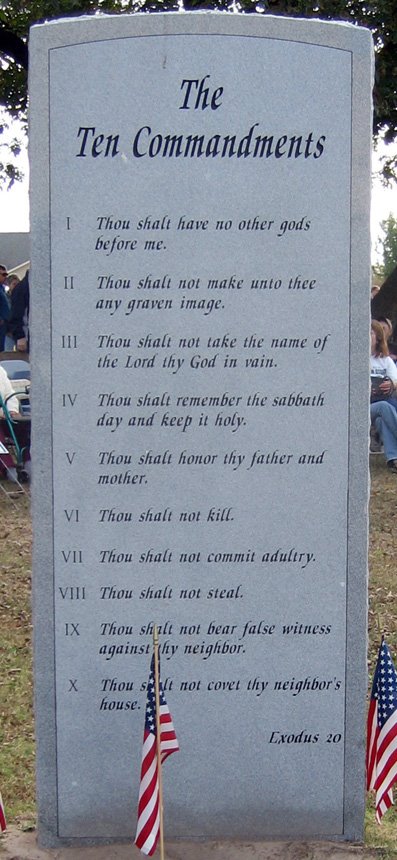
 Lawyers for the Haskell County Commissioners in Stigler, Oklahoma have formally filed a Petition of Writ of Certiorari asking the Supreme Court to reverse the decision of the 10th Circuit Court of Appeals ruling that their Monument to American Theocracy is unconstitutional.
One of the arguments the lawyers make in their writ is that the monument is not in a prominent place on the courthouse grounds because it is not posted near the entrance to the courthouse. As the background of the picture on the right shows, the monument is posted near the main street and highway in Stigler -- where it is visible and prominent to every person who walks by the courthouse and/or drives through town.
As the picture on the left shows, the engraver did not know how to spell the word "adultery."
For the record, Haskell County has still not complied with the court's order that it remove the monument from the grounds of their courthouse.
Jeff Zurheide Passes (Revised)

I received notice that Jeff Zurheide, former pastor of First Baptist Church in Oklahoma City, passed away yesterday.
In my opinion, Jeff was the most courageous Baptist minister in the state of Oklahoma during the years that he was at First Baptist in OKC. He was also the premier scholar-preacher in the state.
Don't take my word for it. Examine the record for yourself. Here are some links from the archives of the Mainstream Messenger:
Response to the 2000 Baptist Faith and MessageToday a lyric from an old song appears sad but true: "It seems the good, they die young."
Herschel Hobbs on Baptist Freedom: The 2000 Herschel H. and Frances J. Hobbs Lecture Series at Oklahoma Baptist University.
First Baptist Church Drops Out of the SBC
Distortions by Preservationist Newsletter Destroying Herschel Hobbs Legacy
I'll just add my "Amen!" to the "Well done, thou good and faithful servant" that he's already heard from his Maker.
Associated Baptist Press has run an obituary.
Wednesday, October 28, 2009
Pierard Corrects Land, Again
Richard Land did not take lightly Richard Pierard's criticism of his use of Nazi analogies in regard to healthcare reform proposals. Pierard, a professional historian and a scholar of German history, seems to have hit a raw nerve in Land, head of the Southern Baptist Convention's Ethics and Religious Liberty Commission. Land complained to Baptist Press, "The last time I checked, Dr. Pierard had not been made speech czar."
Pierard responds to Land's complaint in an essay today on Ethics Daily. His strongest comments, however, were addressed to all Southern Baptists:
Pierard responds to Land's complaint in an essay today on Ethics Daily. His strongest comments, however, were addressed to all Southern Baptists:
Southern Baptists should be just as disturbed by Land's statements because he has brought his denomination into disrepute. His half-hearted repentance included the suggestion that he would continue to expose the ideas of "lethal and deadly philosophies loose in 20th century Germany prior to the Nazis' ascendancy to power" that seemed to be relevant to contemporary life-and-death issues. In other words, it appears he will continue to draw on the Nazi analogy when it might help him in the struggle with other Christians who do not share his views on "life" issues.
The concerns many of us have about Land's own civility inevitably reflect back on the integrity of the denomination that appointed him and stands behind him. Both he and his superiors need to reflect carefully on what Christian speech is really all about and on their need to turn their backs on old ways of expressing disagreement. This is truly a question of "ethics."
Still Looking for a Prophet
In the fall of 2005 Phil Strickland, former head of the Christian Life Commission of the Baptist General Convention of Texas, was to be the speaker at the annual Texas Baptist Committed breakfast. Phil was too sick to deliver the speech. His speech on "Where Have All the Prophets Gone?" was read for him by George Mason, pastor of Wilshire Baptist Church in Dallas.
Phil's concerns are as pertinent today as they were then, perhaps more so. Here's his conclusion:
Phil's concerns are as pertinent today as they were then, perhaps more so. Here's his conclusion:
We desperately need a "theology of enough." We are stewards, not owners, of what we have, at least in Christian teaching. So do we have any walls around what we will spend on ourselves? Do we have any sense of enough for ourselves? That's where the prophets will emerge.
Ah, but what about one more -- denominations. Should they take risk and speak prophetically or declare that the only real role of the denomination is meeting the need of the churches who are a member of the BGCT? To me the answer is easy. Meeting the will of churches, vital as it is, comes in behind one other: listening for and meeting the will of God.
What trumps the prophetic role in denominations is fear of financial loss, and the lack of understanding what crosses they are willing to die on, if any. What is so compelling that a denomination will stand there and ignore the consequences? Do we know the answer to that question? The question must be asked of laypeople and pastors and churches.
A half century ago in this very city some of the brightest lights of Baptists shone in church pulpits. One of the brightest was Blake Smith, pastor of the University Baptist Church. One Sunday morning he stood tall in that pulpit and declared that it was past time that the University of Texas open its doors to all Texas citizens. The time for integration had come. What's more, he said to his all-white church, the time had come for University Baptist Church to open its doors to all for whom Christ died.
Well, right after the benediction the predictable took place. An emergency deacons meeting was called for that afternoon. For hours those men grumbled on about what the preacher had said that morning, about whether he had the right to say those things, about the autonomy of the local church to decide who would and who would not be its members, about whether Blake Smith ought tobe their pastor at all. After all long while, the moderator looked to the back of the room where an old respected judge was sitting quietly. The man said, "Judge, we haven't heard from you on this matter. What do you think?" The judge rose to his feet and said solemnly, "Well, boys, you know I don't like what our pastor said this morning any more than any of the rest of you. But I think Jesus liked it a lot." Motion to adjourn.
Where have all the prophets gone?
Tuesday, October 27, 2009
Finding Common Ground Between Baptists and Muslims
The Baptist Center for Ethics has posted a 90 second trailer (above) and several brief video clips (here) for their documentary "Different Books, Common Word."
The documentary will air on ABC-TV affiliate stations beginning in January 2010.
Here's a link to a story about the documentary on Ethics Daily.
It was a privilege and honor for me to be one of the people interviewed for this documentary.
Monday, October 26, 2009
Al Mohler on Conscience
Al Mohler, President of Southern Seminary and architect of the heretical 2000 Baptist Faith and Message statement, has taken up writing about conscience lately. Today, he writes about "The Idolatrous Religion of Conscience" and concludes with a quote from Martin Luther:
For the record, I too believe that conscience can be elevated to idolatrous levels. No one should trust a conscience that is not informed by both scripture and by the Holy Spirit (Mohler also turns a deaf ear to God's Spirit).
I also find it ironic that Mohler cites Martin Luther so approvingly. I'm not sure where the quote he cites is to be found in Luther's corpus, but I'm certain that you can find quotes similar to this in Luther's denunciations of the Anabaptists whose conscience prohibited them from baptizing infants. Instead, they insisted on baptizing believers.
"It is the nature of all hypocrites and false prophets to create a conscience where there is none, and to cause conscience to disappear where it does exist."I find it ironic that Mohler is now demonstrating such concern about forms of idolatry. Particularly when the article on "Scriptures" that he wrote for the 2000 Baptist Faith and Message demoted Jesus and elevated the Bible to such and extent that his statement is the clearest expression of Bible idolatry ever approved by a Baptist convention.
For the record, I too believe that conscience can be elevated to idolatrous levels. No one should trust a conscience that is not informed by both scripture and by the Holy Spirit (Mohler also turns a deaf ear to God's Spirit).
I also find it ironic that Mohler cites Martin Luther so approvingly. I'm not sure where the quote he cites is to be found in Luther's corpus, but I'm certain that you can find quotes similar to this in Luther's denunciations of the Anabaptists whose conscience prohibited them from baptizing infants. Instead, they insisted on baptizing believers.
Friday, October 23, 2009
The SBC's Unethical Ethician Strikes Again
You might expect the President of an agency entitled "The Ethics and Religious Liberty Commission" to be scrupulous about speaking the truth and honoring promises. You should expect the same from the head of the ethical ageny of the largest Protestant denomination in America. Unfortunately, Richard Land, President of the Southern Baptist Convention's political arm and ethical agency, appears to have few scruples about mendacity and promise breaking.
On September 26th Land declared democratic proposals for healthcare reform to be "precisely what the Nazi's did." He bestowed on Dr. Ezekiel Emanuel, President Obama's healthcare advisor, "The Dr. Jospeh Mengele Award." Mengele was a notorious Nazi death camp doctor.
When Abraham Foxman of the AntiDefamation League complained about his inappropriate use of Nazi analogies, Land denied he intended to say what he clearly said, apologized, and promised not to use such analogies in the future.
Land lied. As Brian Kaylor at Ethics Daily points out, Baptist Press, the propaganda arm for the Southern Baptist Convention, is still printing stories that indicate Land still stands by his Nazi analogies.
Richard Land's remarks prompted the Interfaith Alliance to write an open letter calling for civility and asking public speakers to refrain from holocaust comparisons.
On September 26th Land declared democratic proposals for healthcare reform to be "precisely what the Nazi's did." He bestowed on Dr. Ezekiel Emanuel, President Obama's healthcare advisor, "The Dr. Jospeh Mengele Award." Mengele was a notorious Nazi death camp doctor.
When Abraham Foxman of the AntiDefamation League complained about his inappropriate use of Nazi analogies, Land denied he intended to say what he clearly said, apologized, and promised not to use such analogies in the future.
Land lied. As Brian Kaylor at Ethics Daily points out, Baptist Press, the propaganda arm for the Southern Baptist Convention, is still printing stories that indicate Land still stands by his Nazi analogies.
Richard Land's remarks prompted the Interfaith Alliance to write an open letter calling for civility and asking public speakers to refrain from holocaust comparisons.
Jesus and Conscience
Jesus did not use the word for conscience. He spoke about the heart.
Jesus perceives that people honor God with their lips, but their hearts are far from him. (Mk. 7:6) His mission is to seek and save those who are lost in their sin and guilt. He likens his message to a seed that brings forth much fruit when it falls on the good ground of an honest and good heart that will hear it and keep it. (Luke 8:15)
Those who hear Jesus and look at themselves through his eyes, begin to perceive how they appear in God's sight. Through Jesus' eyes the proud and self-righteous discover that they are unacceptable to God, though they may not believe it. On the other hand, penitent sinners see that, in spite of their sin, God loves them, accepts them, and wants to transform their hearts and lives.
Lives are transformed by a wholehearted response to Christ's call to discipleship. Jesus commands his disciples to turn away from a life of sin and calls them to follow him, his teachings and his example. Disciples are to bear witness to the character and quality of Christ's life, sacrificial death and resurrection by the character and quality of their own life of sacrificial love and service. Literally, disciples are to be ready and willing to give up their lives for others in the same humble, self-sacrificing Spirit in which Christ took up a cross and died for all humanity.
Short of making the ultimate sacrifice, Jesus expects his disciples to maintain a pure heart by loving God with all their heart, with all their soul, with all their mind, and with all their strength, by loving their neighbors as themselves, by loving each other as he has loved them, and by loving even their enemies.
Jesus perceives that people honor God with their lips, but their hearts are far from him. (Mk. 7:6) His mission is to seek and save those who are lost in their sin and guilt. He likens his message to a seed that brings forth much fruit when it falls on the good ground of an honest and good heart that will hear it and keep it. (Luke 8:15)
Those who hear Jesus and look at themselves through his eyes, begin to perceive how they appear in God's sight. Through Jesus' eyes the proud and self-righteous discover that they are unacceptable to God, though they may not believe it. On the other hand, penitent sinners see that, in spite of their sin, God loves them, accepts them, and wants to transform their hearts and lives.
Lives are transformed by a wholehearted response to Christ's call to discipleship. Jesus commands his disciples to turn away from a life of sin and calls them to follow him, his teachings and his example. Disciples are to bear witness to the character and quality of Christ's life, sacrificial death and resurrection by the character and quality of their own life of sacrificial love and service. Literally, disciples are to be ready and willing to give up their lives for others in the same humble, self-sacrificing Spirit in which Christ took up a cross and died for all humanity.
Short of making the ultimate sacrifice, Jesus expects his disciples to maintain a pure heart by loving God with all their heart, with all their soul, with all their mind, and with all their strength, by loving their neighbors as themselves, by loving each other as he has loved them, and by loving even their enemies.
Thursday, October 22, 2009
KSBI Reports on OCC Press Conference
KSBI-TV has also posted a report about the the press conference for healthcare reform that the Oklahoma Conference of Churches sponsored Tuesday.
Here's a link. KSBI uses another sound bite from my statement.
Here's a link. KSBI uses another sound bite from my statement.
Wednesday, October 21, 2009
OETA Reports on OCC Healthcare Reform Press Conference

The local PBS affiliate made the Oklahoma Conference of Churches' press conference on healthcare reform their top story yesterday.
Click on the ONR 10-20-09 Report or on the picture that looks like the one above. A preview of the press conference coverage is at the 1:20 mark. Full coverage of the press conference begins at the 5:10 mark.
About half of my statement makes it into the report.
Tuesday, October 20, 2009
Supporting Healthcare Reform
The Oklahoma Conference of Churches is holding a press conference at the State Capitol this afternoon to support healthcare reform. Here is what I plan to say:
I am a Baptist minister and I am here to speak on behalf of the many Baptists who expect our elected leaders to assure that healthcare is accessible, affordable, accountable, and inclusive of all persons.
I am also here to apologize for the heartlessness and indifference of the many Baptists and other Christians who appear to identify more with the priest and the Levite than with the Samaritan in the parable of the good Samaritan.
When we see someone who is sick, injured and beaten down by life in our society our first question should not be "Who sinned and made this person poor and uninsured?" Instead, our first question should be "What can I do to help?"
More than anything else, you can help by demanding that healthcare be accessible, affordable, accountable and inclusive of all persons.
Have a heart, America! Demand healthcare reform.
Note: Thanks to Andy Watts for suggesting phrases used in this statement.
Monday, October 19, 2009
On Using God
Wade Burleson has posted an insightful blog about the facility with which some Christians use God as an explanation for actions with questionable integrity and intentionality. He cites some notorious examples within the SBC takeover movement and makes a worthwhile suggestion:
Bottom line: I wish Christian people would simply state the plain truth and stop spiritualizing everything. How many pastors say "God has called me to another church" when it is more accurate to say "I have an opportunity to go to a bigger church that will pay me a larger salary which will possibly enhance the opportunties and influence I have in terms of my ministerial career." I, frankly, would find the latter--if ever said--refreshing.
Friday, October 16, 2009
Better Late Than Never

Richard Land has finally apologized for equating the Obama administration's plan for heathcare with the work of the Nazi death camp doctor Joseph Mengele.
After receiving a letter of complaint from the Anti-Defamation League (ADL) and a personal contact from its leader, Land disingenuously denied that he intended to equate Obama's healthcare proposals with anything related to the Holocaust. Then, he disingenuously denied that he really intended to equate anyone in the Obama administration with Dr. Mengele.
Ultimately, Land apologized for any hurt his remarks may have caused Holocaust survivors. Baptist Press has yet to publish a story about his "apology."
I guess this pseudo-apology is better late than never.
As head of the political arm of the largest Protestant denomination in America, Land ought to have known better from the beginning.
Wednesday, October 14, 2009
Mclaren Asks Obama to Reconsider War in Afghanistan
Brian Mclaren has posted an Open Letter to President Obama on the War in Afghanistan.
He asks the President to "find another way ahead in Afghanistan."
I wholeheartedly agree.
He asks the President to "find another way ahead in Afghanistan."
I wholeheartedly agree.
Tuesday, October 13, 2009
Conscience in Classical Greece and Hellenistic Culture
The Greeks were the first people to speak of conscience in the sense in which we use the word. Contrary to what some highly regarded biblical scholars have asserted, the term was not "invented" by the Stoics nor was it predominantly used by them. The materialist philosopher Democritus (460-360 BC) was the first person recorded to have used the Greek word for consciousness, synoida, with the moral sense of conscience:
The closest any early Greek comes to the idea of a good conscience is the historian Xenophon (430-354) who bears witness within himself that he does good works: "We know with ourselves that we began as children and still continue in the practice of noble and good works."
All of the other early Greek references to "know with ourselves" are associated with an internal witness to something bad. A fragment from the dramatist Menander (342-291 BCE) suggests that, in the world of politics, anyone who bears witness within himself, no matter how brave, will be terrorized by what he knows. The historian Polybius (203-120 BCE) writes that "there is no witness as fearful nor accuser as terrible as the conscience which dwells in every man’s soul."
One of the earliest portrayals of the effects of conscience came from the tragedian Euripedes (480-406 BCE) in Orestes, a play about a son who was advised by the god Apollo to avenge the death of his father by killing his mother who murdered him:
Some men, not knowing the dissolution of mortal nature, suffer wretchedly throughout their lifetime from distress and fear because of their consciousness of the evildoing in their lives, making false speculations about the time after death.Few believe that Democritus was doing anything more than taking up a usage for the word that was popular and common in his time. Synoida literally meant "to know in common with" and was often used for knowledge about which you could bear witness for or against another person. In the sense of conscience, you are bearing witness for or against yourself.
The closest any early Greek comes to the idea of a good conscience is the historian Xenophon (430-354) who bears witness within himself that he does good works: "We know with ourselves that we began as children and still continue in the practice of noble and good works."
All of the other early Greek references to "know with ourselves" are associated with an internal witness to something bad. A fragment from the dramatist Menander (342-291 BCE) suggests that, in the world of politics, anyone who bears witness within himself, no matter how brave, will be terrorized by what he knows. The historian Polybius (203-120 BCE) writes that "there is no witness as fearful nor accuser as terrible as the conscience which dwells in every man’s soul."
One of the earliest portrayals of the effects of conscience came from the tragedian Euripedes (480-406 BCE) in Orestes, a play about a son who was advised by the god Apollo to avenge the death of his father by killing his mother who murdered him:
Orestes: Here I am, the murderer of my wretched mother.Philo of Alexandria (20 BC – 50 AD), a Hellenistic Jewish philosopher, describes conscience as something that wages war within the soul:
Menelaus: I have heard, spare your words; evils should be seldom spoken.
Orestes: I will be sparing; but the deity is lavish of woe to me.
Menelaus: What ails you? What is your deadly sickness?
Orestes: My conscience; I am aware of having done terrible things.
Come now, if you please, and with your reason look into the mind of the man who is about to swear to a falsehood; and you will see that it is not tranquil, but full of disorder and confusion, accusing itself, and enduring all kinds of insolence and evil speaking; for the conscience which dwells in, and never leaves the soul of each individual, not being accustomed to admit to itself any wicked thing, preserves its own nature always such as to hate evil, and to love virtue, being itself at the same time an accuser and a judge; being roused as an accuser it blames, impeaches, and is hostile; and again as a judge it teaches, admonishes, and recommends the accused to change his ways, and if he be able to persuade him, he is with joy reconciled to him, but if he be not able to do so, then he wages an endless and implacable war against him, never quitting him neither by day, nor by night, but pricking him, and inflicting incurable wounds on him, until he destroys his miserable and accursed life.The historian Plutarch (46-120 AD), a native of Greece who became a Roman citizen, described the conscience as like an ulcer:
Like an ulcer in the flesh. It implants in the soul a remorse which never ceases to wound and to goad it. Any other pain can be reasoned away, but this remorse is inflicted by reason, on the soul which is so racked with shame, and self-chastised. For just as those overcome by shivering fits, or burning with fever, suffer worse and are in greater distress than those who suffer the equivalent, but external, heat or cold, so the pains which come as it were from without and by chance are more easy to bear. But the cry "None other is to blame for this but myself" coming from within upon the wicked man's own sins, makes his sufferings yet harder to bear.One of the most widely quoted statements about the Greek conscience, erroneously attributed to the Stoic philosopher Epictetus (55-135 AD) by the historian of music Marcus Meibomius (1630-1710), is from an unknown author and dates from around 90 AD:
When we were children our parents handed us over to a nursery-slave who should watch over us everywhere lest harm befall us. But when we are grown up, God hands us over to the conscience implanted in us, to protect us. Let us not in any way despise its protection, for should we do so we shall be both ill-pleasing to God and have our own conscience as an enemy.
Monday, October 12, 2009
Cut Out the in-your-face Religiosity
Ethics Daily has posted an outstanding essay by Zach Dawes about the hypocrisy of Christians who only believe in religious liberty for themselves. Here's a quote:
Probably the best way to explain the issue is to change the group promoting their religious sayings. What if there were quotations from the Quran or the Book of Mormon or another religious group on the banner? What if the majority of the community was atheist and the banners read, "There is no god: eat, drink and be merry"? Would it be acceptable to continue displaying such statements? If no, why is it acceptable for Christians, but not others?There are people bright enough to comprehend this in nearly every church in America. Why can't we put an end to the in-your-face religiosity in the public square that masquerades as a kind of tactless, insensitive and aggressive evangelism?
This is the problem often missed amid the sloganized and pejorative banter. This decision is not a denial of Christians' rights to freely express their beliefs. It's a defense of non-Christians' rights to not have Christian beliefs forced upon them.
Friday, October 09, 2009
Podcast: Politics, Religion and Conscience
Podcast (27 MB Mp3) of Dr. Bruce Prescott's 10-4-09 "Religious Talk" radio broadcast. I read and comment on Neal Gabler's outstanding Op-Ed on "Religion as Politics" and then talk about Baptists, liberty of conscience, and the need for a passionate progressive faith.
Thursday, October 08, 2009
Oklahoma: Nearly the Worst Healthcare in America
The Commonwealth Fund has ranked the health care systems by for all fifty states and the District of Columbia.
Ranked at number 50: Oklahoma. Only Mississippi is ranked lower.
Click here see how other states compare.
Of course, the rest of the country really didn't need Commonwealth to weigh in. All they need do to form an opinion about the quality of healthcare most Oklahomans value is to listen to rhetoric about healthcare from Oklahoma Senator Tom Coburn, M.D.
Ranked at number 50: Oklahoma. Only Mississippi is ranked lower.
Click here see how other states compare.
Of course, the rest of the country really didn't need Commonwealth to weigh in. All they need do to form an opinion about the quality of healthcare most Oklahomans value is to listen to rhetoric about healthcare from Oklahoma Senator Tom Coburn, M.D.
Socrates' Conscience
Hannah Arendt, the great Jewish-German philosopher, traced the roots of the Western philosophic understanding of conscience to Socrates. Central to her view is Socrate' refusal to accept contradiction within himself. Socrates is reported to have said,
Internal dialogue with self is inescapable for Socrates. You can walk away from other people when you have a disagreement, but you cannot walk away from yourself. When you do what you know is wrong, you are witness against yourself and cannot get away from your accuser. You condemn yourself to live with self-reproach.
More than anything else, Socrates wanted to be able to be hold an internal dialogue with himself with integrity and thereby be able to live with himself. That's why he said, "It is better to suffer wrong than do wrong." (Georgias 475c)
Socrates thought teaching people how to think without contradiction would enable them to live without contradiction. For him, morality was founded on the inner intercourse between self with itself. If each person conducted that dialogue with integrity, he thought, there would be no need for external rules or standards.
Ancient Athens thought Socrates teaching corrupted the morals of the city's youth. He encouraged them to examine the traditional beliefs on which morality had been based. In their eyes, undermining unquestioning belief and obedience threatened the harmony of city life.
Athens passed a death sentence on Socrates for disrupting the peace and tranquility of their society. Socrates willingly suffered this injustice rather than actually undermine the rule of law by fleeing the city.
Arendt contends that the morality of Socrates proved inadequate for ordinary political life and is "relevant only in times of crisis." She repeatedly cites examples from dissidents and opponents to the Nazi regime who explained their behavior by claiming, "I couldn't live with myself if I followed orders." For her, the Socratic "self as the ultimate criterion of moral conduct is politically a kind of emergency measure."
It would be better for me that my lyre or a chorus I direct were out of tune and loud with discord, and that most men should not agree with me and contradict me, rather than that I, being one, should be out of tune with myself and contradict myself. (Georgias 482b-c)Socrates could not abide with hypocrisy. For him, the silent inner dialogue with oneself is what constitutes the self into a person. Who could desire to be at odds with their own self? The most important thing in life is to know yourself and be at one with yourself.
Internal dialogue with self is inescapable for Socrates. You can walk away from other people when you have a disagreement, but you cannot walk away from yourself. When you do what you know is wrong, you are witness against yourself and cannot get away from your accuser. You condemn yourself to live with self-reproach.
More than anything else, Socrates wanted to be able to be hold an internal dialogue with himself with integrity and thereby be able to live with himself. That's why he said, "It is better to suffer wrong than do wrong." (Georgias 475c)
Socrates thought teaching people how to think without contradiction would enable them to live without contradiction. For him, morality was founded on the inner intercourse between self with itself. If each person conducted that dialogue with integrity, he thought, there would be no need for external rules or standards.
Ancient Athens thought Socrates teaching corrupted the morals of the city's youth. He encouraged them to examine the traditional beliefs on which morality had been based. In their eyes, undermining unquestioning belief and obedience threatened the harmony of city life.
Athens passed a death sentence on Socrates for disrupting the peace and tranquility of their society. Socrates willingly suffered this injustice rather than actually undermine the rule of law by fleeing the city.
Arendt contends that the morality of Socrates proved inadequate for ordinary political life and is "relevant only in times of crisis." She repeatedly cites examples from dissidents and opponents to the Nazi regime who explained their behavior by claiming, "I couldn't live with myself if I followed orders." For her, the Socratic "self as the ultimate criterion of moral conduct is politically a kind of emergency measure."
Wednesday, October 07, 2009
The Hebrew Conscience
The Hebrew Bible has no word for "conscience." Instead, the word "heart" is used in ways that resemble our understanding of "conscience."
In places, the Old Testament envisions the heart as a moral guide. David prays for Solomon to have "a perfect heart, to keep thy commandments" (1 Chron. 29:19) and Solomon prays for "an understanding heart to judge Your people to discern between good and evil." (1 Kings 3:9) Jeremiah sees a day when God will make a "new covenant" with his people and will put his "law within them and on their heart." (Jere. 31:31-34).
The strongest impulses of the heart, however, are predominantly viewed as untrustworthy and deceitful (Jere. 17:9). Rabbinic Judaism distinguished two drives within the human heart. An evil inclination (Yetzer Hara) rooted in essential biological drives that issue in a psychological proclivity toward selfishness and a good inclination (Yetzer Hatov) that grows with moral and intellectual understanding and shapes the personality for good in proportion to the degree to which the heart adheres to God's law.
The primary expressions of conscience in the Old Testament are associated with experiences of guilt due to the failure to keep the law. From the beginning, law-breaking was viewed as exposing oneself to shame in the eyes of others (Gen. 3). David's heart was recorded to be "smote" (KJV), "troubled" (NASB), "conscience-stricken" (NIV) after he numbered the people (2 Sam. 24:10, cf. 1 Sam. 24:5) The Psalmist confesses "I know my transgressions, and my sin is ever before me" (Ps. 51:3) and prays "Create in me a clean heart, O God" (Ps. 51:10).
While conscience is primarily viewed as adherence to God's law, there are also biblical passages in which conscience appears as a "spiritual audacity" bold enough to argue and reason with God. Abraham questions whether the entire population of Sodom and Gomorrah deserves judgment (Gen. 18:20-33), Moses successfully intercedes for the Children of Israel when God declares his intention to destroy them (Ex. 32:9-14), and the Psalmist accuses God of sleeping while his people are given into the hands of their enemies like sheep to be eaten (Psalm 44).
Consciences free to challenge omnipotence and influence God himself will not be afraid of questioning the moral authority of their leaders and of challenging the injustices of any earthly potentate. Amos denounces societies that trample on the heads of the poor and deny justice to the oppressed (Amos 2:7), Micah objects to leaders who pronounce judgment for a bribe, priests who instruct for a price, and prophets who divine for money (Micah 3:11), and Ezekiel abhors the arrogance of cities like Sodom where there was abundant food and careless ease, but no help for the poor and needy (Ezekiel 16:49).
In places, the Old Testament envisions the heart as a moral guide. David prays for Solomon to have "a perfect heart, to keep thy commandments" (1 Chron. 29:19) and Solomon prays for "an understanding heart to judge Your people to discern between good and evil." (1 Kings 3:9) Jeremiah sees a day when God will make a "new covenant" with his people and will put his "law within them and on their heart." (Jere. 31:31-34).
The strongest impulses of the heart, however, are predominantly viewed as untrustworthy and deceitful (Jere. 17:9). Rabbinic Judaism distinguished two drives within the human heart. An evil inclination (Yetzer Hara) rooted in essential biological drives that issue in a psychological proclivity toward selfishness and a good inclination (Yetzer Hatov) that grows with moral and intellectual understanding and shapes the personality for good in proportion to the degree to which the heart adheres to God's law.
The primary expressions of conscience in the Old Testament are associated with experiences of guilt due to the failure to keep the law. From the beginning, law-breaking was viewed as exposing oneself to shame in the eyes of others (Gen. 3). David's heart was recorded to be "smote" (KJV), "troubled" (NASB), "conscience-stricken" (NIV) after he numbered the people (2 Sam. 24:10, cf. 1 Sam. 24:5) The Psalmist confesses "I know my transgressions, and my sin is ever before me" (Ps. 51:3) and prays "Create in me a clean heart, O God" (Ps. 51:10).
While conscience is primarily viewed as adherence to God's law, there are also biblical passages in which conscience appears as a "spiritual audacity" bold enough to argue and reason with God. Abraham questions whether the entire population of Sodom and Gomorrah deserves judgment (Gen. 18:20-33), Moses successfully intercedes for the Children of Israel when God declares his intention to destroy them (Ex. 32:9-14), and the Psalmist accuses God of sleeping while his people are given into the hands of their enemies like sheep to be eaten (Psalm 44).
Consciences free to challenge omnipotence and influence God himself will not be afraid of questioning the moral authority of their leaders and of challenging the injustices of any earthly potentate. Amos denounces societies that trample on the heads of the poor and deny justice to the oppressed (Amos 2:7), Micah objects to leaders who pronounce judgment for a bribe, priests who instruct for a price, and prophets who divine for money (Micah 3:11), and Ezekiel abhors the arrogance of cities like Sodom where there was abundant food and careless ease, but no help for the poor and needy (Ezekiel 16:49).
Tuesday, October 06, 2009
Another Outrageous Lie From Richard Land
Richard Land, head of the political action arm of the Southern Baptist Convention, told members of the Christian Coalition in Florida that the healthcare reform proposed by the Obama administration is "pro-euthaniasia" and is "precisely what the Nazis did."
Land's speech in Florida is filled with such outrageous lies and distortions that it sounds like a rant from someone who is either mentally unbalanced or else is attempting to foment the violent overthrow of our government. That he should be the chief ethical spokesperson for the largest protestant denomination in our nation is unfathomable.
Meanwhile, millions of perfectly sane Southern Baptists who are embarrassed by Land's lies continue to give tithes and offerings to churches that forward a percentage of their money to support Land's work.
That doesn't make sense to me either.
Land's speech in Florida is filled with such outrageous lies and distortions that it sounds like a rant from someone who is either mentally unbalanced or else is attempting to foment the violent overthrow of our government. That he should be the chief ethical spokesperson for the largest protestant denomination in our nation is unfathomable.
Meanwhile, millions of perfectly sane Southern Baptists who are embarrassed by Land's lies continue to give tithes and offerings to churches that forward a percentage of their money to support Land's work.
That doesn't make sense to me either.
Monday, October 05, 2009
The Conscience of Ancient Egyptians
The earliest records we have of any kind of moral philosophy date from between the 28th and the 25th Century BCE. The Maxims of Ptahhotep, compiled by the Grand Vizier under the Pharoah Isesi of the Fifth Dynasty in the 25th Century BCE, have been described as the "earliest formulation of right conduct to be found in any literature."
James H. Breasted in his 1934 book The Dawn of Conscience describes how in the Maxims of Ptahhotep the word for "heart" is used in ways that resemble our understanding of "conscience." The heart that hearkens to good advice is understood to be like a mentor or "wise guide."
Ptahhotep's idea of the heart as a wise guide influenced Egyptian thought for centuries. Breasted quotes a fifteenth century BCE court herald describing how his heart guided him in his service for the conqueror Thutmose III:
The perceptions that most concerned ordinary people of the Osirian faith in ancient Egypt were those of the forty-two lesser gods that sit in the court of the "Great God" on the day of judgment. The Egyptian Book of the Dead is filled with magic charms and incantations giving the dead power over the gods to prevent them from entering a complaint against them about their sins. The dead never confess their sins. Instead, the goal seems to be to be able to stand before the "Great God" and declare "I am one of pure mouth and pure hands, to whom was said 'Welcome, welcome' by those (the gods) who saw him." Those concerned that their own conscience would betray them as their heart was being weighed on the balances could purchase an amulet of a sacred beetle inscribed with the words, "O my heart, rise not up against me as a witness" to be placed over their heart in the grave. They could also add a chapter on "Preventing that the Heart of a Man Oppose Him in the Nether World" to their scroll of the Book of the Dead.
Those who worshipped the Sun–god, Aton, had a more conscientious religion. About Aton, Pharoah Akhenaton has been interpreted as saying that when the sun set and men slept, "Yet art thou still in my heart." Those of the Solar faith worshipped a god devoted to truth. They turned away from the magic of the Osirian faith and found relief from the guilt of sin by humble confession and repentance. For them, the goal seems to have been a quiet, inner communion with god that provided direction for their life.
James H. Breasted in his 1934 book The Dawn of Conscience describes how in the Maxims of Ptahhotep the word for "heart" is used in ways that resemble our understanding of "conscience." The heart that hearkens to good advice is understood to be like a mentor or "wise guide."
Ptahhotep's idea of the heart as a wise guide influenced Egyptian thought for centuries. Breasted quotes a fifteenth century BCE court herald describing how his heart guided him in his service for the conqueror Thutmose III:
It was my heart which caused that I should do them, by its guidance of my affairs. It was . . . as an excellent witness. I did not disregard its speech, I feared to transgress its guidance. I prospered thereby greatly, I was successful by reason of that which it caused me to do, I was distinguished by its guidance.Records show that the ancient Egyptians had great concern for impartially administered justice and for generosity toward the hungry and thirsty, widows, orphans, the naked and the poor. They set a limit, however, to the weight that should be given to the perceptions of strangers. Vizier Kheti of the Pyramid Age was said to have "discriminated against some of the people of his own kin [in favour of] strangers, for fear lest it should be said of him that he [favoured] his [kin dishon]estly." Later generations denounced excessive concern for impartiality as "more than justice" and exhorted later Viziers not to follow his example.
‘Lo, . . .’ said the people, ‘it is an oracle of God in every body. Prosperous is he whom it has guided to the good way of achievement.’
Lo, thus I was.
The perceptions that most concerned ordinary people of the Osirian faith in ancient Egypt were those of the forty-two lesser gods that sit in the court of the "Great God" on the day of judgment. The Egyptian Book of the Dead is filled with magic charms and incantations giving the dead power over the gods to prevent them from entering a complaint against them about their sins. The dead never confess their sins. Instead, the goal seems to be to be able to stand before the "Great God" and declare "I am one of pure mouth and pure hands, to whom was said 'Welcome, welcome' by those (the gods) who saw him." Those concerned that their own conscience would betray them as their heart was being weighed on the balances could purchase an amulet of a sacred beetle inscribed with the words, "O my heart, rise not up against me as a witness" to be placed over their heart in the grave. They could also add a chapter on "Preventing that the Heart of a Man Oppose Him in the Nether World" to their scroll of the Book of the Dead.
Those who worshipped the Sun–god, Aton, had a more conscientious religion. About Aton, Pharoah Akhenaton has been interpreted as saying that when the sun set and men slept, "Yet art thou still in my heart." Those of the Solar faith worshipped a god devoted to truth. They turned away from the magic of the Osirian faith and found relief from the guilt of sin by humble confession and repentance. For them, the goal seems to have been a quiet, inner communion with god that provided direction for their life.
Friday, October 02, 2009
Striving for a Good Conscience
Conscience involves a recognition of personal responsibility (2 Cor. 5:10). We all have a conscience because we all must give an account for what we do with the freedom and power God has given us.
How do we know what God expects?
We first learn what God expects from the law. God gave us the law to assist us in looking at ourselves through His eyes. The law shows us that sin is repulsive in God’s eyes. A guilty conscience is one that looks at its own soul through the eyes of the law and sees the stain of sin.
The law, however, is not the final measure of conscience. It is only a "tutor" that leads us through childhood toward a more mature relation in which we come to see God as a Father. (Gal. 4:1-7)
We learn to see God as a Father by looking at ourselves through the eyes of his Son. Jesus perfectly reveals what God expects. When we look at ourselves through His eyes, we see that, in spite of our sins, God loves us and wants to forgive us. That is why the gospel is good news! Those who accept God's love receive power to conquer sin and be free of guilt. We are authorized to look at ourselves as new persons, as sons of God, and joint heirs with Christ.
No one grasped the implications of this better than the apostle Paul. He was the first person on record to claim to have a "good conscience." (Acts 23:1) He did that while on trial before the Sanhedrin. When he did so, the High Priest — presumably in good conscience — immediately ordered someone to "strike him on the mouth." (Acts 23:2) People have disputed appeals to conscience ever since.
Conflict with the Sanhedrin was inevitable for Paul. He was using a different standard by which to measure conscience. The Sanhedrin measured their consciences by a law that was written by the finger of God on tablets of stone. Paul was measuring his conscience by the Spirit of Christ whose finger he felt clearly on his own heart.
Paul’s dispute with the Sanhedrin should serve as a signal for caution when matters of conscience are being weighed. We will all give an account for what we do with the freedom and power God has given us.
We will all be held personally responsible for every inflammatory opinion we express, for every incendiary action we take, and for every uncharitable vote we make. Those missing or absent when issues of conscience are raised will not escape accountability.
Until that final account is made, each person is required to examine their own conscience. The best way to do that is to measure it by what Jesus revealed that God expects.
That's why Paul says we must appear before the judgment seat of "Christ." It's also the best reason for asking "What would Jesus do?"
When you truly do what Jesus would do, you’ll have a good conscience.
Having a clear conscience, however, is no guarantee that your conscience is good. Some people have a clear conscience when others correctly believe they shouldn't. Another may have a conscience that is clear and good when others incorrectly think he shouldn't.
In the end, we all have to live with our own consciences.
That's why the best we can try to do is strive to have a good conscience.
Ultimately, judging the goodness of consciences belongs to God.
How do we know what God expects?
We first learn what God expects from the law. God gave us the law to assist us in looking at ourselves through His eyes. The law shows us that sin is repulsive in God’s eyes. A guilty conscience is one that looks at its own soul through the eyes of the law and sees the stain of sin.
The law, however, is not the final measure of conscience. It is only a "tutor" that leads us through childhood toward a more mature relation in which we come to see God as a Father. (Gal. 4:1-7)
We learn to see God as a Father by looking at ourselves through the eyes of his Son. Jesus perfectly reveals what God expects. When we look at ourselves through His eyes, we see that, in spite of our sins, God loves us and wants to forgive us. That is why the gospel is good news! Those who accept God's love receive power to conquer sin and be free of guilt. We are authorized to look at ourselves as new persons, as sons of God, and joint heirs with Christ.
No one grasped the implications of this better than the apostle Paul. He was the first person on record to claim to have a "good conscience." (Acts 23:1) He did that while on trial before the Sanhedrin. When he did so, the High Priest — presumably in good conscience — immediately ordered someone to "strike him on the mouth." (Acts 23:2) People have disputed appeals to conscience ever since.
Conflict with the Sanhedrin was inevitable for Paul. He was using a different standard by which to measure conscience. The Sanhedrin measured their consciences by a law that was written by the finger of God on tablets of stone. Paul was measuring his conscience by the Spirit of Christ whose finger he felt clearly on his own heart.
Paul’s dispute with the Sanhedrin should serve as a signal for caution when matters of conscience are being weighed. We will all give an account for what we do with the freedom and power God has given us.
We will all be held personally responsible for every inflammatory opinion we express, for every incendiary action we take, and for every uncharitable vote we make. Those missing or absent when issues of conscience are raised will not escape accountability.
Until that final account is made, each person is required to examine their own conscience. The best way to do that is to measure it by what Jesus revealed that God expects.
That's why Paul says we must appear before the judgment seat of "Christ." It's also the best reason for asking "What would Jesus do?"
When you truly do what Jesus would do, you’ll have a good conscience.
Having a clear conscience, however, is no guarantee that your conscience is good. Some people have a clear conscience when others correctly believe they shouldn't. Another may have a conscience that is clear and good when others incorrectly think he shouldn't.
In the end, we all have to live with our own consciences.
That's why the best we can try to do is strive to have a good conscience.
Ultimately, judging the goodness of consciences belongs to God.
A Time for Passionate Progressive Faith
The LA Times has posted an insightful but defeatist essay about "Politics as Religion" by Neal Gabler. Gabler says American conservatism has become a religion and cannot be overcome:
The antidote for the fundamentalist religification of politics will be a passionate progressive faith that advocates with unyielding fervor for equal liberty of conscience for all persons and separation of church and state.
You cannot beat religion with politics, which is why the extreme right "wins" so many battles. The fundamentalist political fanatics will always be more zealous than mainstream conservatives or liberals. They will always be louder, more adamant, more aggrieved, more threatening, more willing to do anything to win. Losing is inconceivable. For them, every battle is a crusade -- or a jihad -- a matter of good and evil.Gabler's diagnosis is fairly astute but the prognosis is not as dire as he projects.
There is something terrifying in this. The media have certainly been cowed; they treat intolerance as if it were legitimate political activity. So have many politicians, and not just the conservative ones who know that if they don't fall in line, they will be run over. This political fundamentalism has also invaded the general culture in deleterious ways. The ugly incivility of recent months is partly the result of political fundamentalists who have nothing but contempt for opposing viewpoints, which gives them license to shout down opponents or threaten them, just as jihadis everywhere do.
Those who oppose the religification of politics may think all they have to do is change tactics, but they are sadly, tragically mistaken. They can never win, because for the political fundamentalists, this isn't political jousting, this is Armageddon.
The antidote for the fundamentalist religification of politics will be a passionate progressive faith that advocates with unyielding fervor for equal liberty of conscience for all persons and separation of church and state.
Thursday, October 01, 2009
Sobering Facts About the U.S. Economy
Since the stock market has been demonstrated to be as risky as a casino, I've been trying to find a conservative form of investing that hedges against the prospect of high rates of inflation in the future. Research led me to consider TIPS (Treasury Inflation Protected Securities). Investigating the possibilities for investing in TIPS led me to a report issued last week by the U.S. Government Accountability Office.
That report, Debt Management: Treasury Inflation Protected Securities Shoulg Play a Heightened Role in Addressing Debt Management Challenges, describes the challenge that the U.S. government is facing in regard to the mountain of debt that must be paid for the enormous budget deficits, war expenses and finance industry bailout of the last nine years. Here are some sobering facts the GAO discusses as it offers TIPS as a tool for the government to manage its debt:
That report, Debt Management: Treasury Inflation Protected Securities Shoulg Play a Heightened Role in Addressing Debt Management Challenges, describes the challenge that the U.S. government is facing in regard to the mountain of debt that must be paid for the enormous budget deficits, war expenses and finance industry bailout of the last nine years. Here are some sobering facts the GAO discusses as it offers TIPS as a tool for the government to manage its debt:
"Treasury’s total outstanding debt increased by $2.3 trillion (25 percent increase in federal debt) since the onset of the economic recession in December 2007." (p.4)Here's one of the reasons why the GAO considers TIPS a good debt strategy for the government:
"At the end of June 2009, Treasury’s outstanding marketable securities stood at $6.6 trillion, an increase of almost $2.1 trillion from December 2007." (p. 4)
"Treasury data states that almost half of the $6.6 trillion in marketable securities is held by foreign investors, as of May 2009." (footnote, p. 4)
"78 percent (or about $5.1 trillion) of the outstanding marketable Treasuries mature by 2015 and will need to be rolled over (or refinanced) -- potentially at higher interest rates." (p. 6)
"CBO’s analysis of the President’s Budgetary Proposals for Fiscal Year 2010 shows -—absent changes in policy -— interest payments on federal debt more than tripling -—to almost $800 billion -— by 2019." (pp. 6-7)
"CBO projects that, absent changes in current policy, the debt held by the public will double in 5 years (from 2008 to 2013) and almost triple in 11 years (from 2008 to 2019). . . . CBO projects that debt held by the public will increase from 41 percent of gross domestic product (GDP) in fiscal year 2008 to 71 percent by the end of fiscal year 2013." (p. 8)
"Governments are well suited to bear inflation risk because periods of inflation are often associated with increased revenues." (p. 2)
Wednesday, September 30, 2009
Conscience and the Word of God
What is the relationship between conscience and the Word of God? To understand that we need some grasp of what conscience is.
No one image or metaphor is adequate to describe conscience. As much as anything else, conscience is the ability to put yourself in the place of others and to look at yourself through the eyes of others. This ability is presupposed by Jesus' injunction, "So in everything, do to others what you would have them do to you, for this sums up the Law and Prophets." (Mt. 7:12 NIV)
There are at least three primary orientations for assuming a standpoint outside ourselves in relation to others. We can assume a standpoint above others, equal to others, or below others. Jesus commands that we exercise this capacity with humility (looking back on ourselves from a standpoint equal to or below others) and not with arrogance (looking down on others).
Arrogance was the chief sin of the Pharisees. They put themselves in the place of God and presumed to look down on others through the eyes of God. They succumbed to the temptation to "be as gods" in the eyes of others. (Gen. 3:5 KJV). Jesus set explicit parameters on this, "Do not judge, or you too will be judged. For in the same way you judge others, you will be judged, and with the measure you use, it will be measured to you." (Mt. 7:1-2 NIV).
The source of the Pharisee's sin was their pride in the law. History demonstrated that neglecting the law would lead to judgment. The Pharisees were determined to defend the law. Forgetting the Spirit of the law, they adhered to its letter. That is why their eyes were veiled. Their consciences were shaped by the letter of the law and not by a Spirit of love. (2 Cor. 3:1-18)
For Pharisees, the law became an idol. It was their standard of perfection. Measuring fidelity to the law required increasingly detailed and narrow interpretations of its meaning. Then the interpretations were enforced as law. By the time Jesus came, their consciences were so insensitive to the Truth that they refused to believe that the age had come when the law would be written on human hearts. Jesus had rejected their interpretations and claimed to fulfill the law -- an impossibility, in Pharisee eyes, and dangerous. With the certainty of consciences shaped by law and measured by reason, they judged it better that "one man die for the people than that the whole nation perish." (John 11:50 NIV)
With this in mind, it may be possible to identify the distraction that has been diverting Baptists' attention from the voice of God in our consciences. Baptists are people of the book. The Bible is the world in which we live and move and have our being. We take pride in the Bible. Too much pride.
The chief sin among Baptists is our inordinate pride in the Bible. History, we have been told, demonstrates that neglecting the Bible leads to judgment. Many Baptists have determined to defend the Bible. Forgetting the Spirit that gives life, we adhere to the letter that kills. (2 Cor. 3:6) Now, Baptist eyes are being veiled because our consciences are being shaped by the law more than by the gospel.
In essence, for Baptists, the Bible has become an idol. The Bible, more than Jesus, is our standard of perfection. Measuring fidelity to the Bible has required increasingly detailed and narrow interpretations of its meaning. For Southern Baptists, these interpretations have been approved as confessions and enforced as creeds. Many Baptists have become so insensitive to the Truth that whenever the Lord leads a professor or pastor or missionary to question an approved interpretation, they are deprived of opportunities to serve.
Baptists need to be reminded that the Word of God that speaks to our conscience is the Living Word. The best way to acknowledge the priority of the Living Word in our lives is to reaffirm that "The criterion by which the Bible is to be interpreted is Jesus Christ." Then we need to try to read the Bible with Jesus' eyes and look at others with the same spirit of humility and sacrificial love with which he looked at them.
No one image or metaphor is adequate to describe conscience. As much as anything else, conscience is the ability to put yourself in the place of others and to look at yourself through the eyes of others. This ability is presupposed by Jesus' injunction, "So in everything, do to others what you would have them do to you, for this sums up the Law and Prophets." (Mt. 7:12 NIV)
There are at least three primary orientations for assuming a standpoint outside ourselves in relation to others. We can assume a standpoint above others, equal to others, or below others. Jesus commands that we exercise this capacity with humility (looking back on ourselves from a standpoint equal to or below others) and not with arrogance (looking down on others).
Arrogance was the chief sin of the Pharisees. They put themselves in the place of God and presumed to look down on others through the eyes of God. They succumbed to the temptation to "be as gods" in the eyes of others. (Gen. 3:5 KJV). Jesus set explicit parameters on this, "Do not judge, or you too will be judged. For in the same way you judge others, you will be judged, and with the measure you use, it will be measured to you." (Mt. 7:1-2 NIV).
The source of the Pharisee's sin was their pride in the law. History demonstrated that neglecting the law would lead to judgment. The Pharisees were determined to defend the law. Forgetting the Spirit of the law, they adhered to its letter. That is why their eyes were veiled. Their consciences were shaped by the letter of the law and not by a Spirit of love. (2 Cor. 3:1-18)
For Pharisees, the law became an idol. It was their standard of perfection. Measuring fidelity to the law required increasingly detailed and narrow interpretations of its meaning. Then the interpretations were enforced as law. By the time Jesus came, their consciences were so insensitive to the Truth that they refused to believe that the age had come when the law would be written on human hearts. Jesus had rejected their interpretations and claimed to fulfill the law -- an impossibility, in Pharisee eyes, and dangerous. With the certainty of consciences shaped by law and measured by reason, they judged it better that "one man die for the people than that the whole nation perish." (John 11:50 NIV)
With this in mind, it may be possible to identify the distraction that has been diverting Baptists' attention from the voice of God in our consciences. Baptists are people of the book. The Bible is the world in which we live and move and have our being. We take pride in the Bible. Too much pride.
The chief sin among Baptists is our inordinate pride in the Bible. History, we have been told, demonstrates that neglecting the Bible leads to judgment. Many Baptists have determined to defend the Bible. Forgetting the Spirit that gives life, we adhere to the letter that kills. (2 Cor. 3:6) Now, Baptist eyes are being veiled because our consciences are being shaped by the law more than by the gospel.
In essence, for Baptists, the Bible has become an idol. The Bible, more than Jesus, is our standard of perfection. Measuring fidelity to the Bible has required increasingly detailed and narrow interpretations of its meaning. For Southern Baptists, these interpretations have been approved as confessions and enforced as creeds. Many Baptists have become so insensitive to the Truth that whenever the Lord leads a professor or pastor or missionary to question an approved interpretation, they are deprived of opportunities to serve.
Baptists need to be reminded that the Word of God that speaks to our conscience is the Living Word. The best way to acknowledge the priority of the Living Word in our lives is to reaffirm that "The criterion by which the Bible is to be interpreted is Jesus Christ." Then we need to try to read the Bible with Jesus' eyes and look at others with the same spirit of humility and sacrificial love with which he looked at them.
Subscribe to:
Posts (Atom)